Flemish single
Description
Flemish Single is a single-manual harpsichord of the Flemish type. Data for configuring this app has been collected from a Frank Hubbard copy of a 1585 instrument built by Hans Moermans in Antwerp.
It is an audio plugin (VST3) and a standalone app for Windows. Like a real harpsichord it has no touch sensitivity: a key plucks the string the same way whatever the speed, and the music is shaped by timing, articulation and the room.The sound is not sampled. Every string is calculated from its physical properties by the model of the string synthesis project: length, wire, pluck position, plectrum and a shared soundboard. Flemish Single is the simple version of that work, an instrument that opens ready to play, with no workbench controls, only what a player wants.
The author considers the first version complete (October 2026). The strings are modelled and fitted to recordings of a real harpsichord, but the soundboard and the rooms are estimates.
Download: standalone app and VST3 plugin for Windows.
Listen
Rendered directly by the plugin with its default settings: meantone temperament, A4 = 415 Hz, a little ambient reverb and the convolution reverb of the Antwerp cathedral nave. A single note, a chord and a high note. Nothing else is added.
The instrument
- Compass. GG to e''', 58 keys, one 8' choir of strings.
- Strings. Lengths from 1.7 metres in the bass to 0.2 metres at the top, and the pluck positions, are read from a plan of a historic instrument. Brass strings in the bass, steel above. The wire gauges follow the table in Hubbard's Three Centuries of Harpsichord Making.
- Plectrum. Raven quill.
- Soundboard. One shared board for all strings, with the strings and the board driving each other, so wolf notes and sympathetic effects come out of the simulation. The board itself is generic, since there are no measurements of it.
- Playing. MIDI in, stereo out, an on-screen keyboard and the computer keyboard. No velocity. The sustain pedal (CC 64) lifts the dampers, which is not historical but harmless.
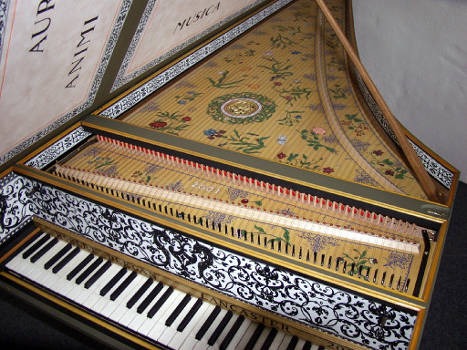
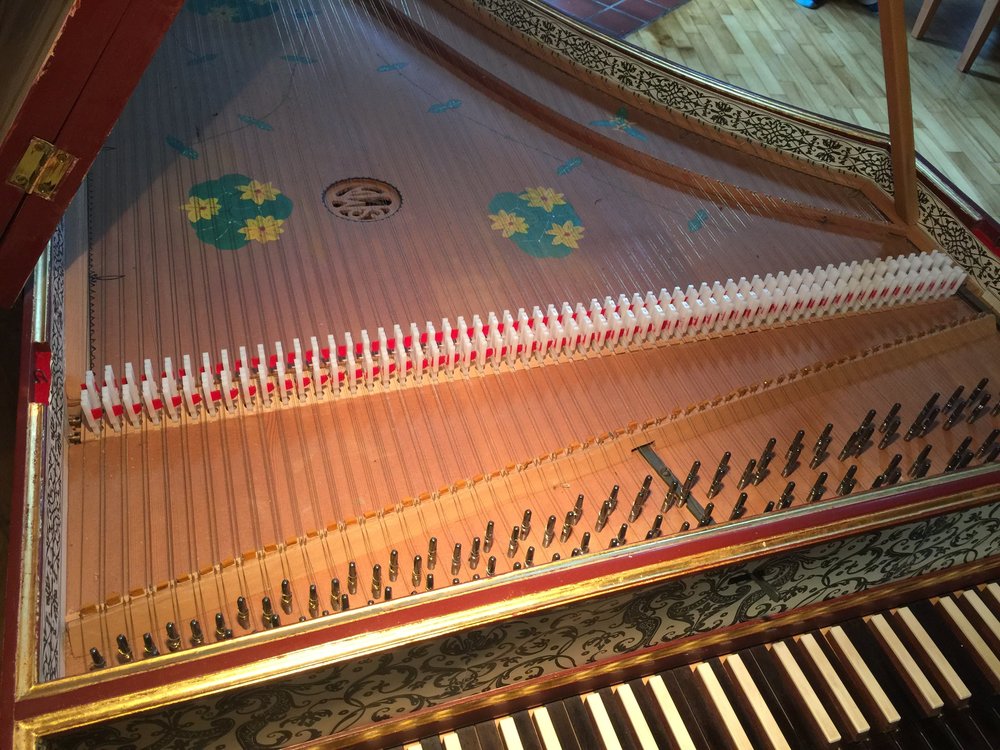
The model is a Flemish single of the Moermans type: one keyboard and one set of strings. The picture shows such an instrument and, below, the jacks and plectra behind the nut, the strings, the soundboard with its painted flowers and the rose.
Controls
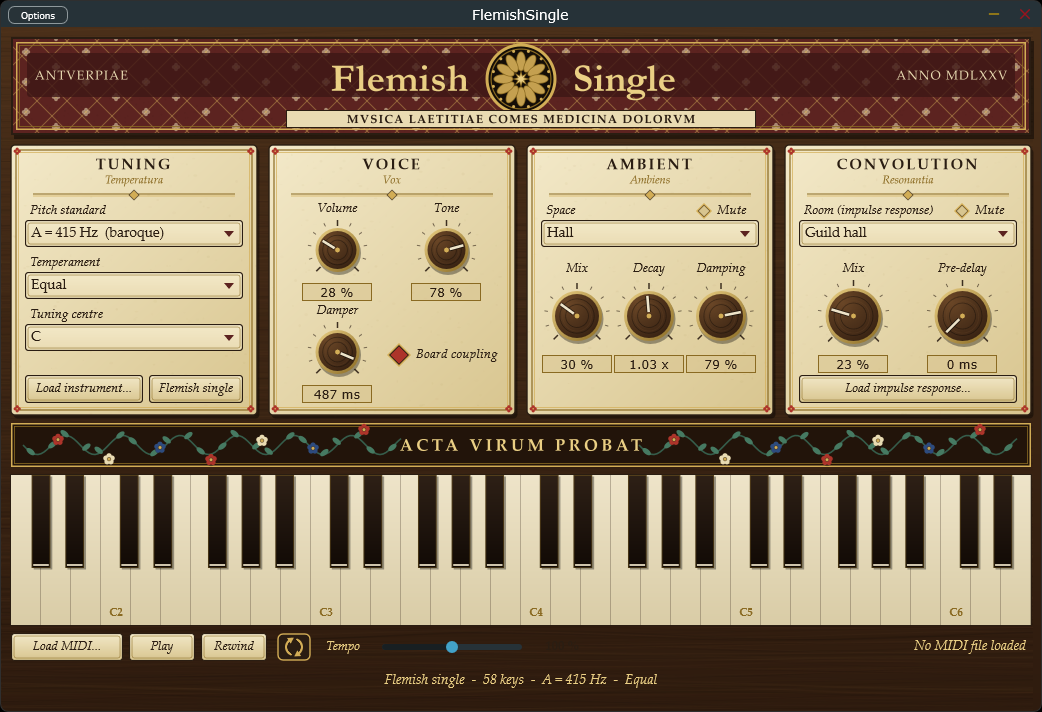
- Pitch standard. 392, 415 (baroque), 440 or 466 Hz. The strings are retuned from their 415 Hz design, so tension and break stress stay those of 415 Hz.
- Temperament. Equal, quarter-comma meantone (the default) or Pythagorean. Tuning centre is the key the chain of fifths starts from, which decides where the wolf fifth falls.
- Volume, Tone and Damper time. Tone is a gentle low-pass filter; damper time is how fast a released key is silenced.
- Board coupling. On by default. Switch it off for exact pitch on every key.
- Load instrument. The built-in instrument is compiled into the plugin. Any instrument file made with the HarpsichordString workbench can be loaded instead.
Rooms
Two reverbs run side by side on the dry sound, each with its own mute switch.
- Ambient reverb. A feedback delay network (the same as in Microtuner) with the spaces Chamber, Hall and Cathedral, and mix, decay and damping.
- Convolution reverb. Four impulse responses made in code: an Antwerp cathedral nave, a Beguinage chapel, a guild hall and a panelled chamber. The decay times are estimates, not measurements. You can also load your own WAV, AIFF or FLAC impulse response.
MIDI file player (standalone app only)
The standalone app has a strip below the keyboard that plays standard MIDI files through the harpsichord, and the on-screen keys follow the music.
- Load MIDI. A menu with the built-in pieces, J.S. Bach's fifteen two-part inventions (BWV 772-786) and fifteen three-part inventions (BWV 787-801), or From computer for any .mid or .midi file. Loading does not start playback.
- Play/Pause, Rewind and Loop. Loop repeats the piece from the start.
- Tempo. 50 to 150 per cent of the file's tempo. Tempo changes in the file are followed.
Only notes and the sustain pedal (CC 64) are used; everything else in the file is ignored, and notes outside GG-e''' are dropped. The loaded file is not saved with the settings. The piece titles are made from the number and key, they are not read from the files. This part is new and has so far been tried with the inventions only.
The look
The whole window is painted in code, with no bitmaps, as a workshop in Antwerp around 1575: oak, a madder-red block-print banner with a gilt lattice, a pierced rosette, parchment panels with gilt rules, turned wooden knobs with a bone pointer and a painted vine on the nameboard. Ruckers' mottoes are on the lid and the ribbon: Musica laetitiae comes medicina dolorum (music, the companion of joy, the medicine of sorrow) and Acta virum probat (the deed proves the man). The brown box reads Antverpiae, anno MDLXXV.
The keyboard has bone naturals running full length and dark accidentals. A key that is pressed, from the mouse, the computer keyboard, MIDI or the MIDI file player, takes on a vermilion tint.
What is missing
VST3 plugin. The MIDI file player is not part of the VST3: a host plays MIDI files itself, so the plugin only takes the MIDI the host sends it. The built-in Bach pieces, the Load MIDI menu and the Play, Rewind, Loop and Tempo controls are therefore found in the standalone app only. The plugin has no window strip for them, so the plugin window is 44 pixels lower than the standalone one.
Both versions.
- One string per key. No 8' and 4' registers, no second manual, no lute stop.
- The model is mono, one listening position; the stereo image comes from the reverbs.
- Pitch standards retune by ratio and do not recompute the strings.
- The window has a fixed size and cannot be resized.
- Windows only. Keys outside GG-e''' are ignored.
Download
Windows, 64 bit. The download page has the standalone app and the VST3 plugin, with instructions.
Questions or comments? Send an e-mail to: thomas@ahlstroem.net