String synthesis
What is HarpsichordString?
HarpsichordString is a physically modelled harpsichord. Instead of playing back recordings it calculates the sound of a plucked string from its physical properties: length, wire material and gauge, where along the string it is plucked, what the plectrum is made of, and how the soundboard and case respond. Change a number and the sound changes the way it would on a real instrument.
The goal is a complete instrument with one string per key, all strings sharing one soundboard. The project consists of a JUCE-free C++ engine and a workbench app where you design and listen to the strings. The same engine is used by Microtuner, which has a STRINGS section that plays these instruments and retunes the strings live.
Work in progress. The sound has been fitted to recordings of a real harpsichord with numbers, but the final judge is the ear, and the fine tuning by listening has only just started.
Listen
These samples are rendered directly by the model, with the Flemish single instrument (see below), a raven quill plectrum and the soundboard coupled to the strings. Nothing is added except a level adjustment and a short fade-out. The pitch is A4 = 415 Hz, so the notes are a semitone below modern pitch. The sound is not tuned by ear yet, so take it as a status report, not a finished instrument.
A short phrase: an arpeggio and a chord
Single notes across the compass
C2, the bass: brass string, 1.7 m long
C3
C4: steel string, 0.75 m long
C5
The string model
Each string is described by a set of parameters and from them the engine builds the sound as a sum of decaying sinusoids, the partials of the string, plus the noise of the pluck.
- Partials. A stiff string is slightly inharmonic: partial n sits at n·f0·√(1 + B·n²). B is calculated from the wire's stiffness, diameter, tension and length. Pitch is an input, so the tension is derived from it and checked against the break stress of the material.
- The pluck. The string is deflected into a triangle at the pluck position and released by the plectrum. The release time (plectrum stiffness and tip width) shapes the spectrum. A pluck close to the nut gives a nasal sound while a pluck at the middle gives a round one. A harpsichord has no velocity – the pluck is the same whatever the speed of the key – so the model has none either.
- Two polarisations. The string vibrates both vertically, which couples strongly to the bridge, and horizontally, which couples weakly. The result is the double decay of a real harpsichord: a quick initial fall followed by a long tail.
- Decay. Each partial decays at its own rate: energy lost to the bridge, air drag, internal friction in the wire and extra damping of the highest partials.
- Soundboard. A rectangular orthotropic plate (spruce, stiffer along the grain) with ribs. Its vibration modes give the bridge a frequency dependent admittance, so a partial that lands on a board resonance dies faster, and the wolf notes of a real instrument can appear.
- Case. A heuristic only: a stiff, heavy case raises the board modes and adds damping.
Designing a string
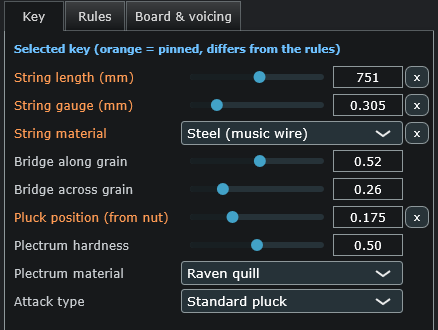
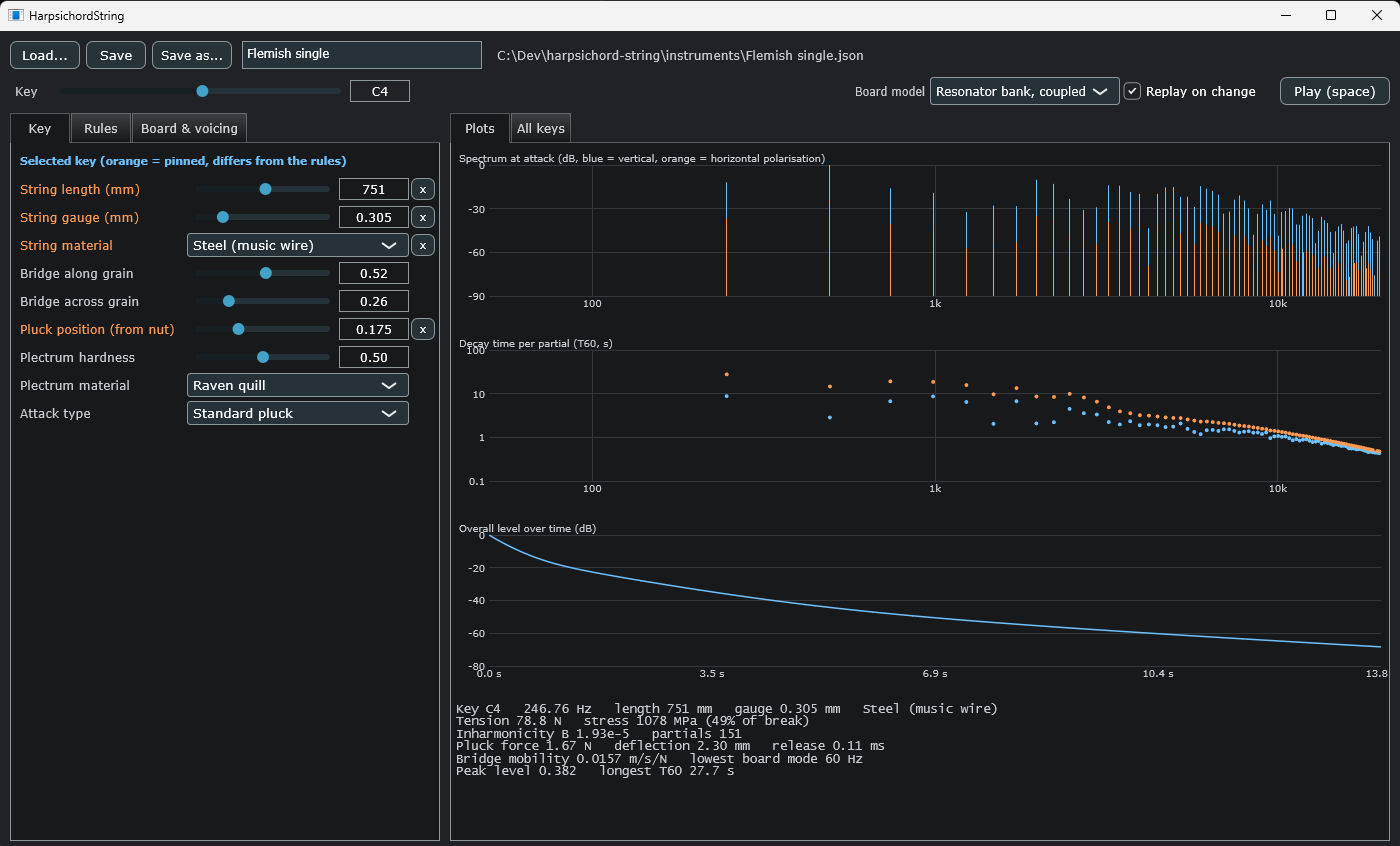
The Key tab holds the parameters of the selected key. The slider at the top selects the key.
- String length and gauge (wire diameter).
- String material: music wire (steel), yellow brass and others.
- Bridge position, along and across the grain of the soundboard.
- Pluck position, as a fraction of the string length measured from the nut.
- Plectrum hardness and material (for example Delrin or raven quill).
- Attack type.
The values come from the rules for the whole instrument (see below) until you change one. A changed value is pinned to the key, the label turns orange, and the small x button hands it back to the rules. A button also finds the length where the string is at 75 % of its break stress.
Plots
Every change is calculated again at once (with Replay on change checked the key is played as well). Three plots show what the model made of it:
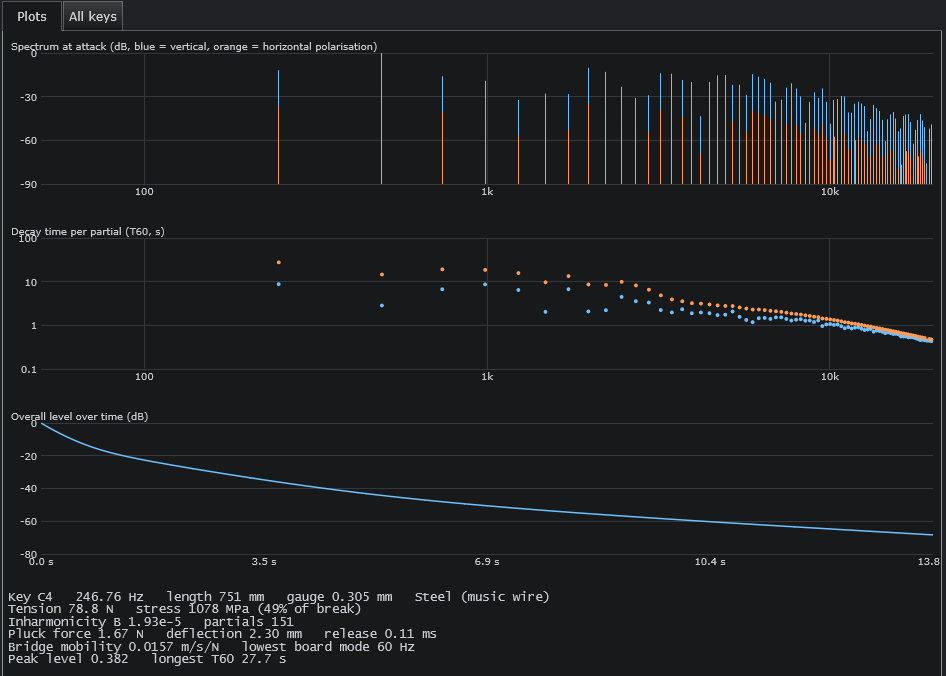
- Spectrum at attack. Level of every partial. Blue is the vertical polarisation, orange the horizontal.
- Decay time per partial (T60). Time for each partial to fall 60 dB. The scatter among the low partials comes from the soundboard resonances.
- Overall level over time.
Below the plots a read-out lists tension, stress as a percentage of break stress, inharmonicity B, pluck force and deflection, bridge mobility and the lowest board mode. Warnings, for example a string too close to breaking, are shown in red.
Rules for a whole instrument
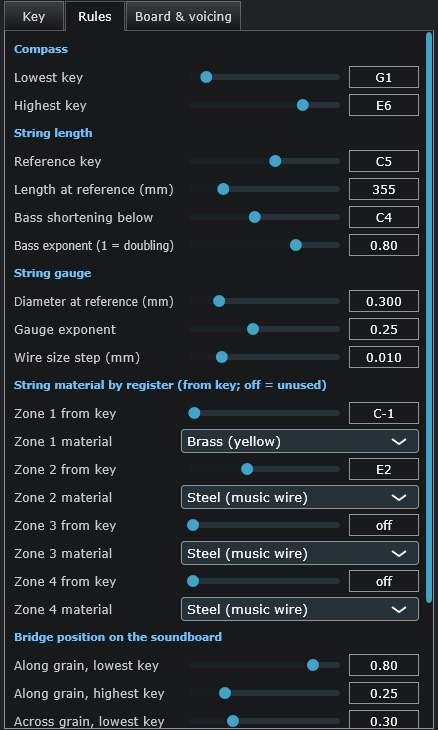
An instrument is a shared soundboard, voicing and a set of rules that give every key its default string, plus a few per-key overrides. The Rules tab sets:
- The compass: lowest and highest key.
- String length: a length at a reference key that doubles per octave down (the exponent is adjustable) and a bass shortening below a chosen key.
- String gauge: diameter at the reference key, how it changes per octave, rounded to real wire sizes.
- String material by register: up to four zones, for example brass in the bass and steel above.
- Bridge position on the soundboard and pluck position, both interpolated across the compass.
Change a rule once and every key follows. Overrides keep individual keys fixed. The instrument is saved as a plain JSON file.
Board & voicing
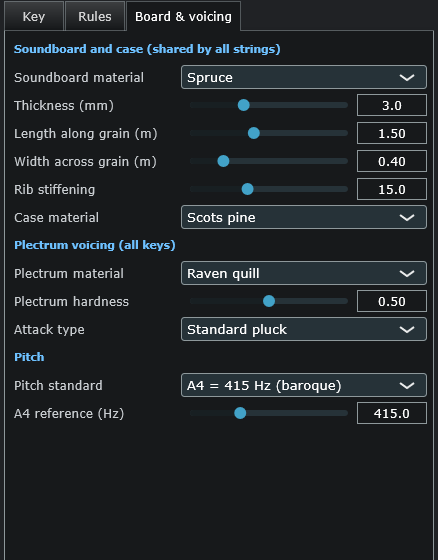
Everything shared by all strings:
- Soundboard material, thickness, size along and across the grain, and rib stiffening.
- Case material.
- Plectrum material, hardness and attack type for the whole instrument.
- Pitch: 392, 415 (baroque), 440 or 466 Hz, or any value with the A4 slider. At 415 Hz the strings carry about 12 % less tension than at 440, and the sound changes with it.
All keys
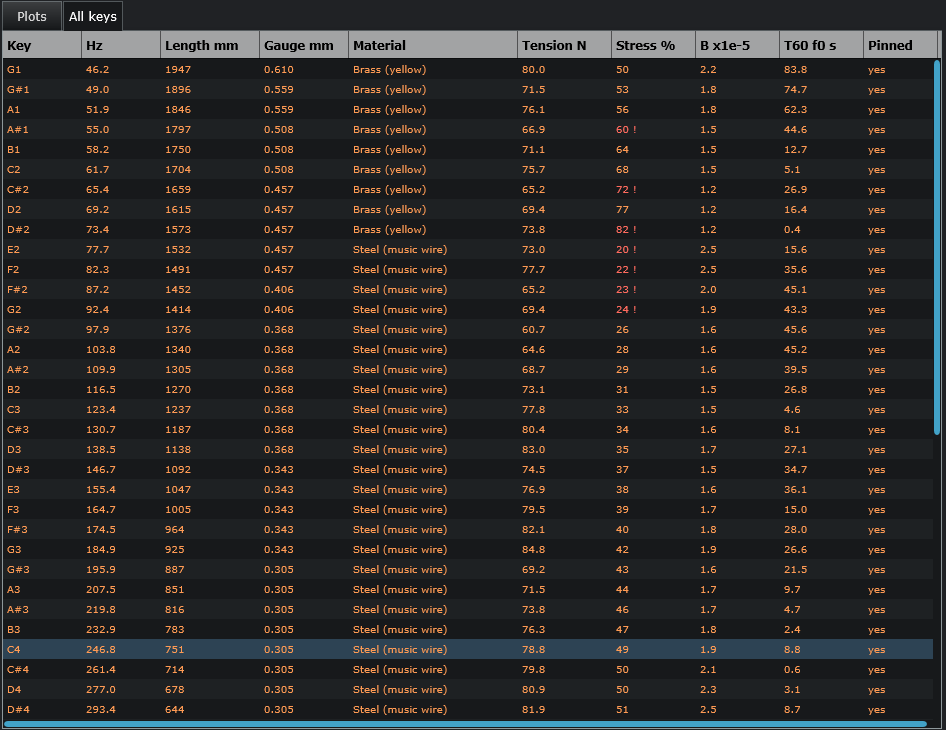
The All keys tab is a table of every key in the instrument: frequency, string length, gauge, material, tension, stress, inharmonicity and decay time of the fundamental. Orange rows are keys pinned by an override, a red exclamation mark is a warning. Click a row to select the key. The table is the quickest way to see whether a scale is even: tension should be about the same on every string and stay well under the break stress.
The soundboard in real time
For playing, all sounding strings are rendered sample by sample through one shared soundboard. The lowest 64 board modes (up to about 1.5 kHz) are simulated as resonators that the strings push their force into. The modes go on ringing after the strings are damped, and the motion of the board drives the strings back. The workbench has a Board model selector to compare three ways by ear:
- Quasi-static: the board answers only with its response curve.
- Resonator bank, one-way: the strings drive the board, but not the other way. Pitch is exact.
- Resonator bank, coupled: full two-way coupling. Strings and board pull each other, as on a real instrument. A string on a board resonance can be pulled several cents out of tune.
A chord of 16 notes uses about 30 % of one processor core.
Calibration against a real harpsichord
The model has been compared with sampled recordings (44 keys, 24 bit) of a real harpsichord, using the same analysis code on the recording and on the model. Things that were measured and fitted:
- The noise of the pluck: broadband and flat per octave up to about 16 kHz, rising over 3 ms and lasting about 100 ms.
- The onset, which rises over 4–6 ms instead of starting with a click.
- The balance between the partials, through a fitted voicing curve.
- Decay times, which are about 8–13 s up to 3 kHz and drop to about 2 s above 3.7 kHz.
- The pluck position, which moves from about 0.12 of the string length in the bass to 0.27 at the top of the range measured.
The result is that partial levels agree within a few dB and decay times within 0.9–1.2 times per octave. The known differences are written down too: the model is louder in the first 100 ms relative to the sustain, and the recorded instrument's own soundboard resonances are not modelled.
A Flemish single-manual instrument
The target is a single-manual Flemish harpsichord, built up step by step. The instrument file Flemish single has a compass of GG to e''' (58 keys) at A4 = 415 Hz and a raven quill plectrum. String lengths, from 1.7 metres in the bass to 0.2 metres at the top, and the pluck positions are read from a plan of a historic instrument. The wire gauges follow the table in Hubbard's Three Centuries of Harpsichord Making, with brass in the bass and steel above. The scale comes out even: 50–80 N of tension on every string, 50–82 % of break stress on the brass and 20–58 % on the steel.
The soundboard, ribs and bridge are still generic, since there are no measurements for them yet.
What is missing
- One string per key; no 8' and 4' registers yet, and so no sympathetic ringing of strings that are not played.
- Soundboard thickness taper and a real radiation model.
- Plectrum protrusion (voicing), which is what really sets the pluck force.
- Undo and unsaved-changes warning in the workbench.
- More listening: the numbers say close, the ears decide.
Questions or comments? Send an e-mail to: thomas@ahlstroem.net